Art for Social Justice: Voices Unheard
Curated by Dr. Tony Cuevas
Art plays a role in spreading awareness to issues involving oppressed communities and helps drive social change by creating platforms for expression, disrupting dominant narratives and asserting cultural identity. This exhibit, through murals by NAU students, attempts to promote inclusion, challenge oppression and focus on social change for marginalized voices.
June 5, 6-8 pm • First Friday ArtWalk Opening Reception
6 pm: Refreshments and hospitality with music by Seenan Bhatti, 7pm: Featured speaker: NAU Associate Professor Tony Cuevas
July 3, 6-8 pm • First Friday ArtWalk Reception
6 pm: Refreshments and hospitality with music by Wild Irish Fiddle 7pm: Featured speaker: Brianna Cardenas artist/NAU Teaching Assistant
Bio: Dr. P. Antonio Cuevas is a nationally recognized, award-winning educator with over 25 years of experience working with incarcerated individuals, gang-affiliated youth, drug-impacted teenagers, and migrant families. His published research, The Journey from De-culturalization to Community Cultural Wealth: The Power of a Counter Story-Telling Curriculum and How Educational Leaders Can Transform Schools, has been implemented institutionally as a core educational pedagogy and has contributed to closing the achievement gap.
As an Assistant Teaching Professor at Northern Arizona University, Dr. Cuevas taught Ethnic Studies courses that examined race, identity, inequality, and social justice through both in-person and online modalities. He is recognized for creating inclusive and engaging learning environments that equip students with the tools to critically analyze systems of power while envisioning equitable alternatives. His teaching reflects a commitment to culturally responsive pedagogy, student-centered learning, and the preparation of future leaders who are ready to advance equity in diverse communities.
The descendant of Spanish-speaking immigrants, Dr. Cuevas brings a multigenerational perspective to the experiences of Latinos in the United States, shedding light on the injustices and racism faced by migrants while honoring their resilience and contributions. He earned his doctorate from California State University, East Bay, in 2013.
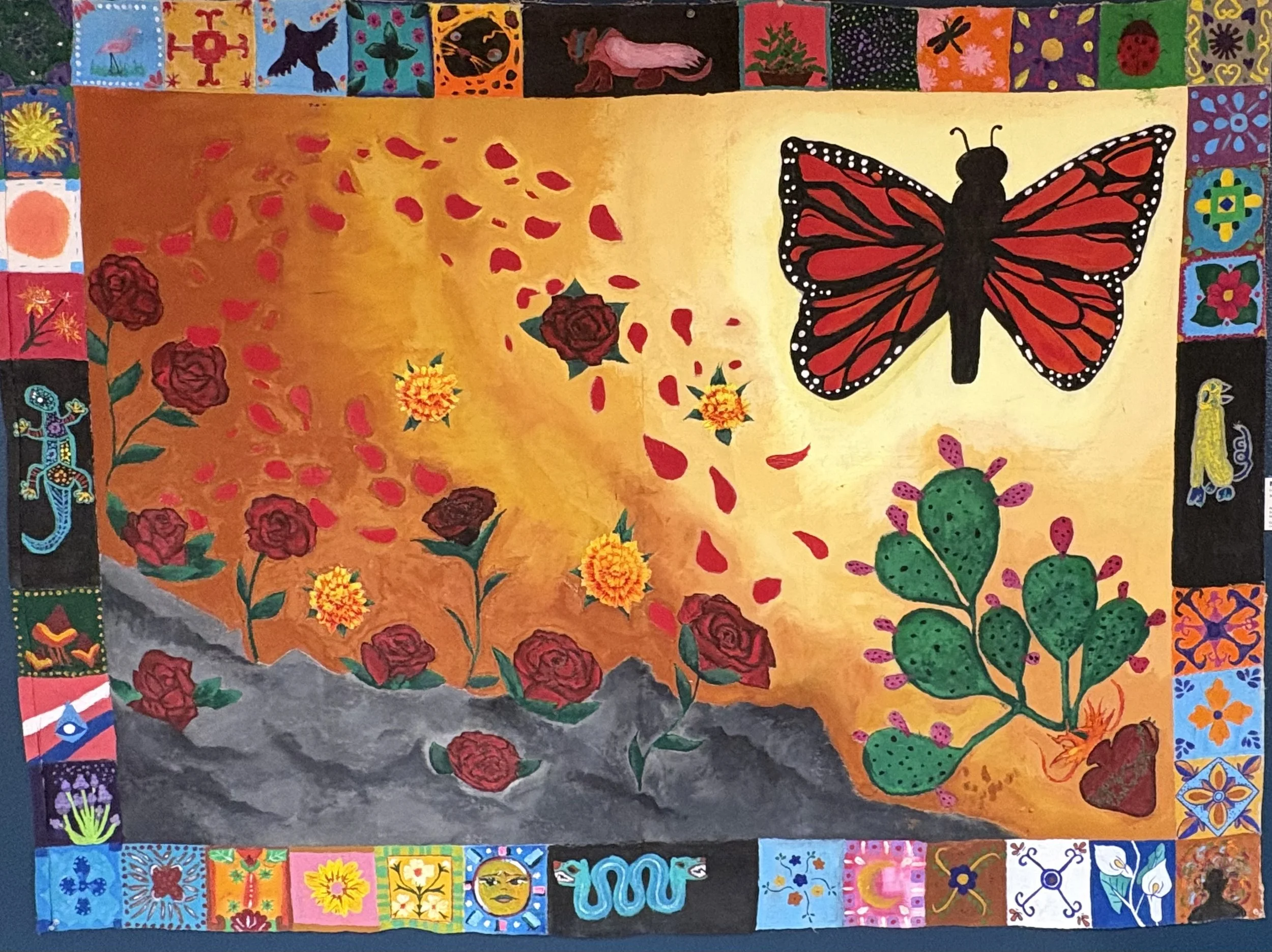
SEMILLAS DEL PASADO
Artists: Liliana (lali) Santiago, Mya Matney, Sophia Garza, Nevaeh Stafford, Amaranta Manzanares-Juarez
Artist statement: Semillas del Pasado, Petals of Tomorrow, honors the resilience and sacrifices of our ancestors while envisioning a future of cultural survival and transformation. The roses breaking through concrete symbolize resistance against oppression, while the petals and monarch butterfly represent future generations and the limitless possibilities available to them. Drawing on Freire’s concepts of dehumanization versus humanization and gestures of love, as well as Yosso’s framework of Community Cultural Wealth, the work emphasizes cultural preservation, re-culturalization, and authentic empowerment over superficial recognition. By weaving in intersectionality (Solórzano) and the power of counter-storytelling (Yosso, Cuevas), the piece challenges dominant narratives and amplifies marginalized voices, ultimately serving as both a tribute to our roots and a call to action for justice and representation.
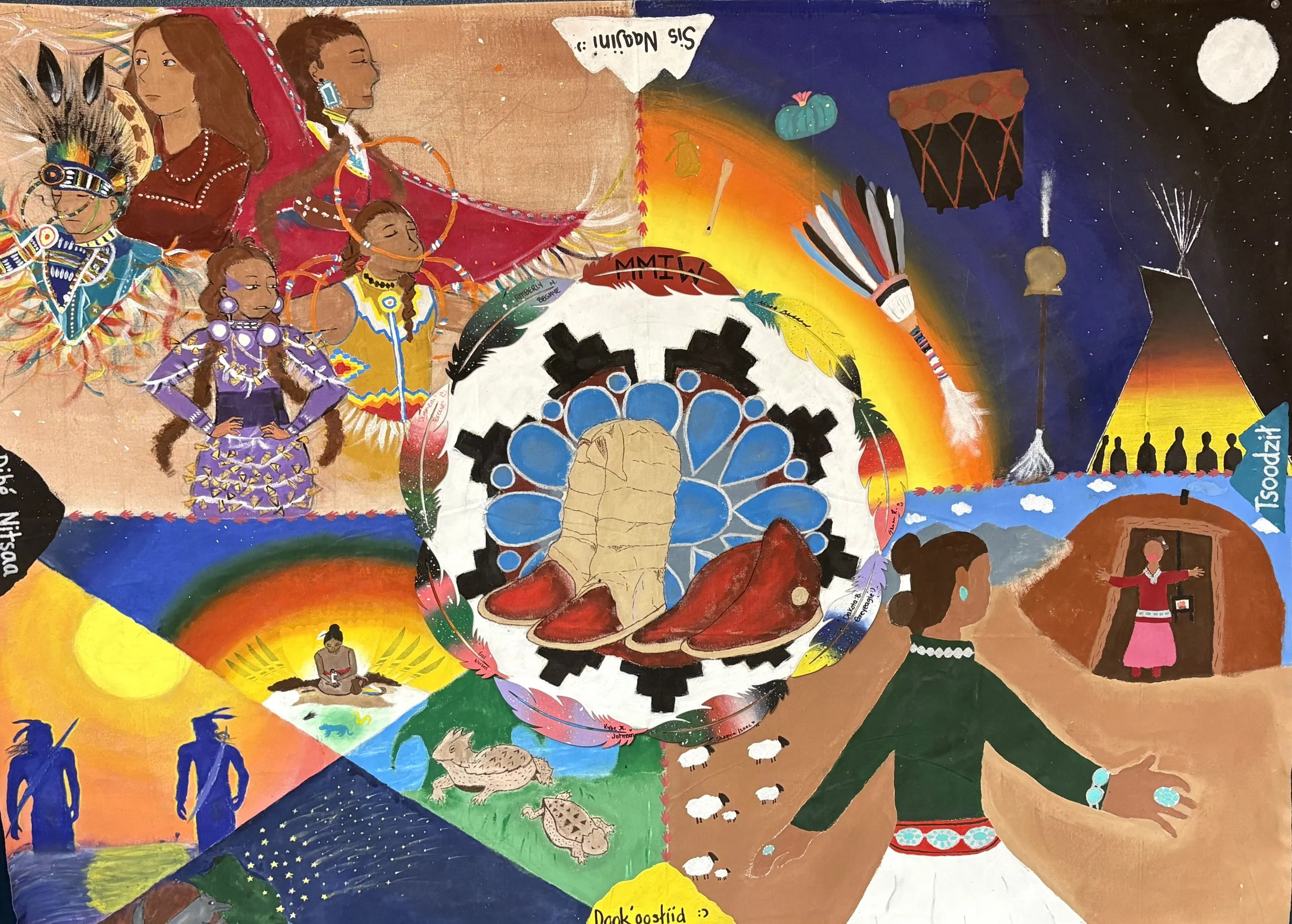
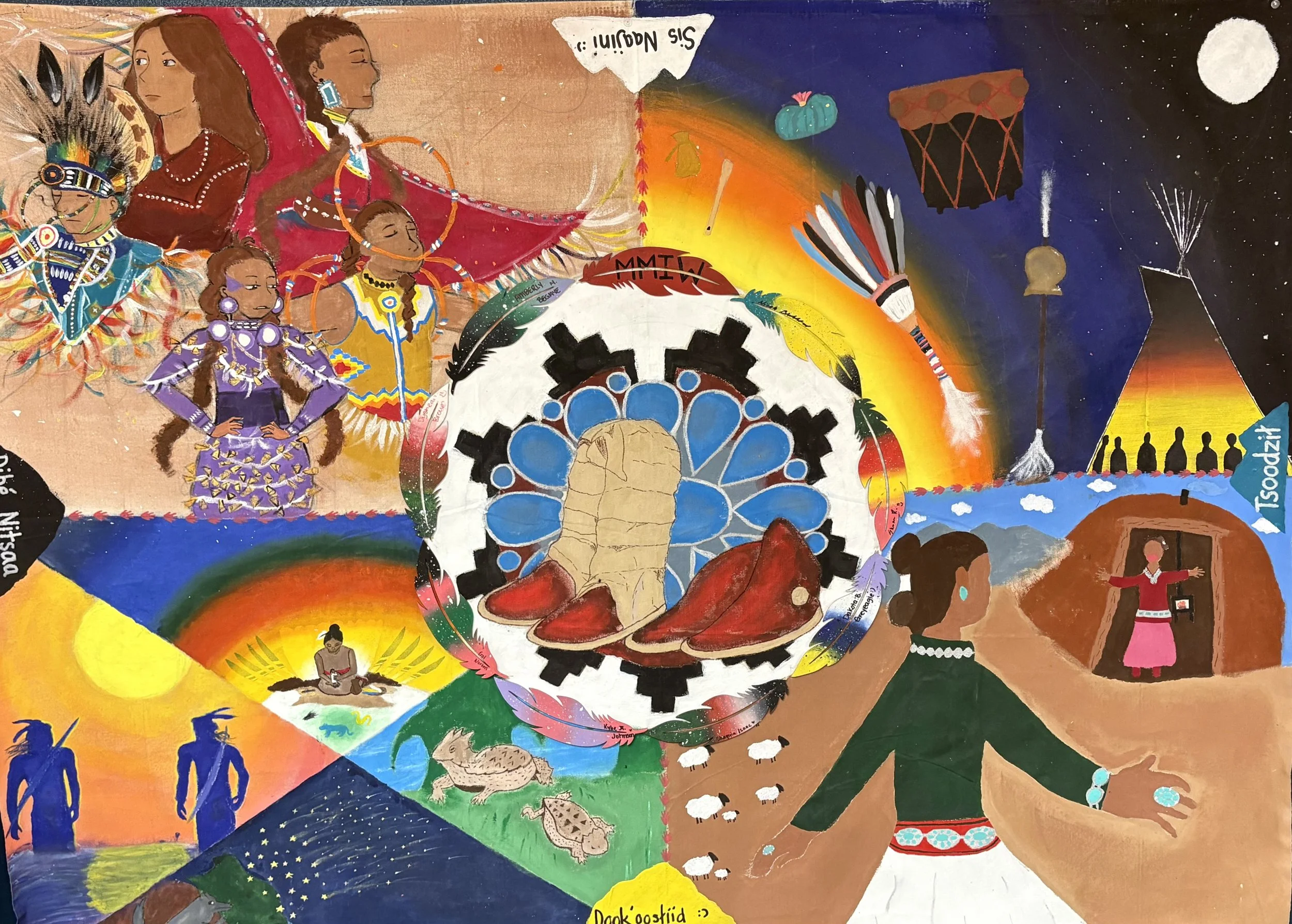
Hozho: A Painting Expressed into Words
Artists: Nicole Blatchford, Kylie Johnson, Dakota Greyeagle, Shaquia Isaac, Shone Reese, and Amberly Begaye in Dr. Cuevas’ Introduction to Ethnic Studies course, in partnership with the STAR First-Gen program and based on his published research and curriculum.
Artist Statement:The piece embodies harmony, peace, love, and tradition, drawing on Navajo stories of Changing Woman, Grandfather Horned Toad (“Cheii”), the twin heroes, and Coyote, as well as cultural practices such as jingle dancing, peyote meetings, and Kinaaldás. At its center, a Navajo basket symbolizes creation and the journey of life—its colors representing marriage, hardship, and personal growth—while moccasins ground the artists to Mother Earth, turquoise embodies protection and ancestral connection, and feathers reflect clan identity and continuity. Red handprints call attention to missing and murdered Indigenous women, reminding us that despite struggle and distraction, culture lives on, grows stronger, and demands recognition.
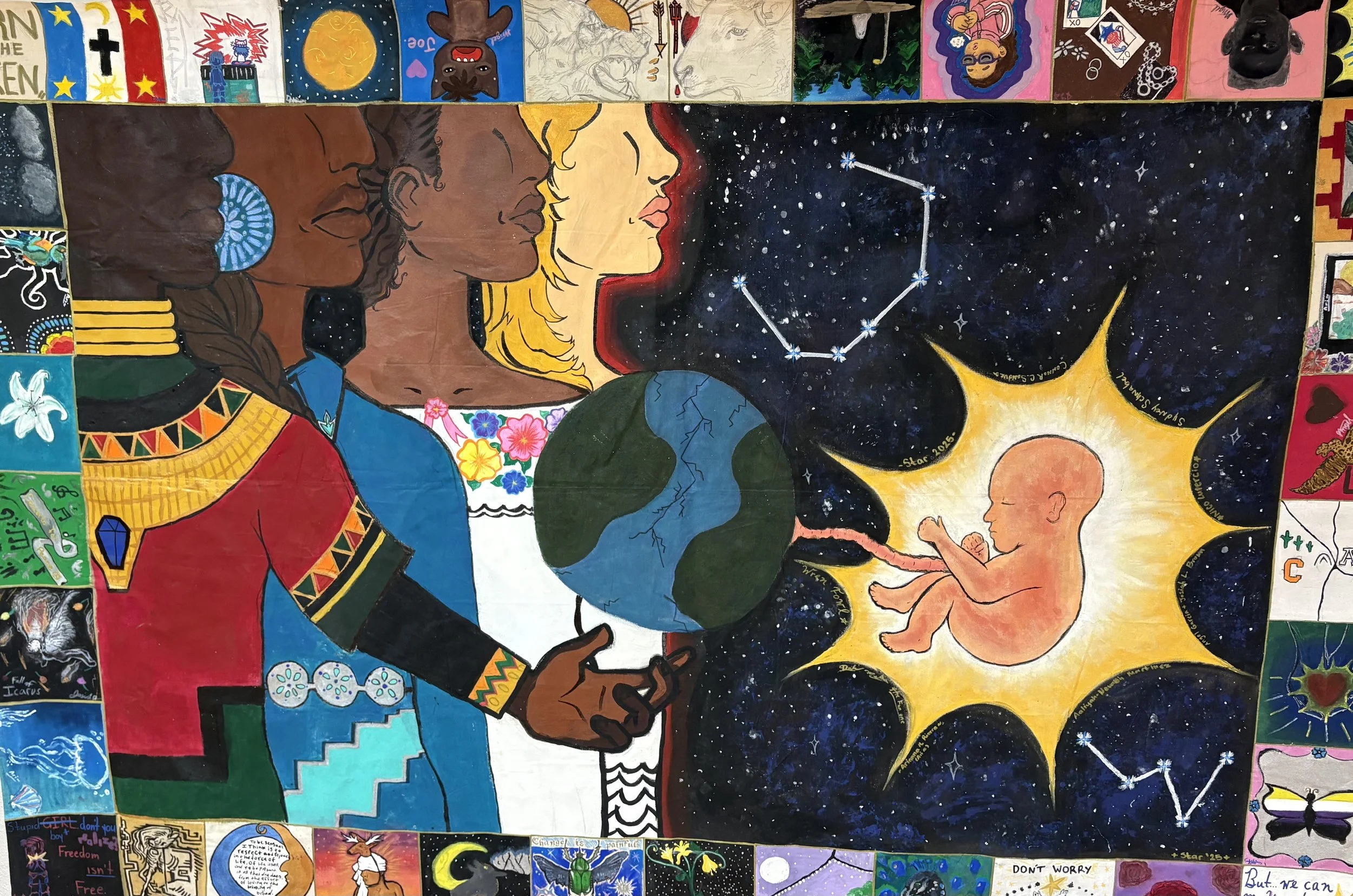
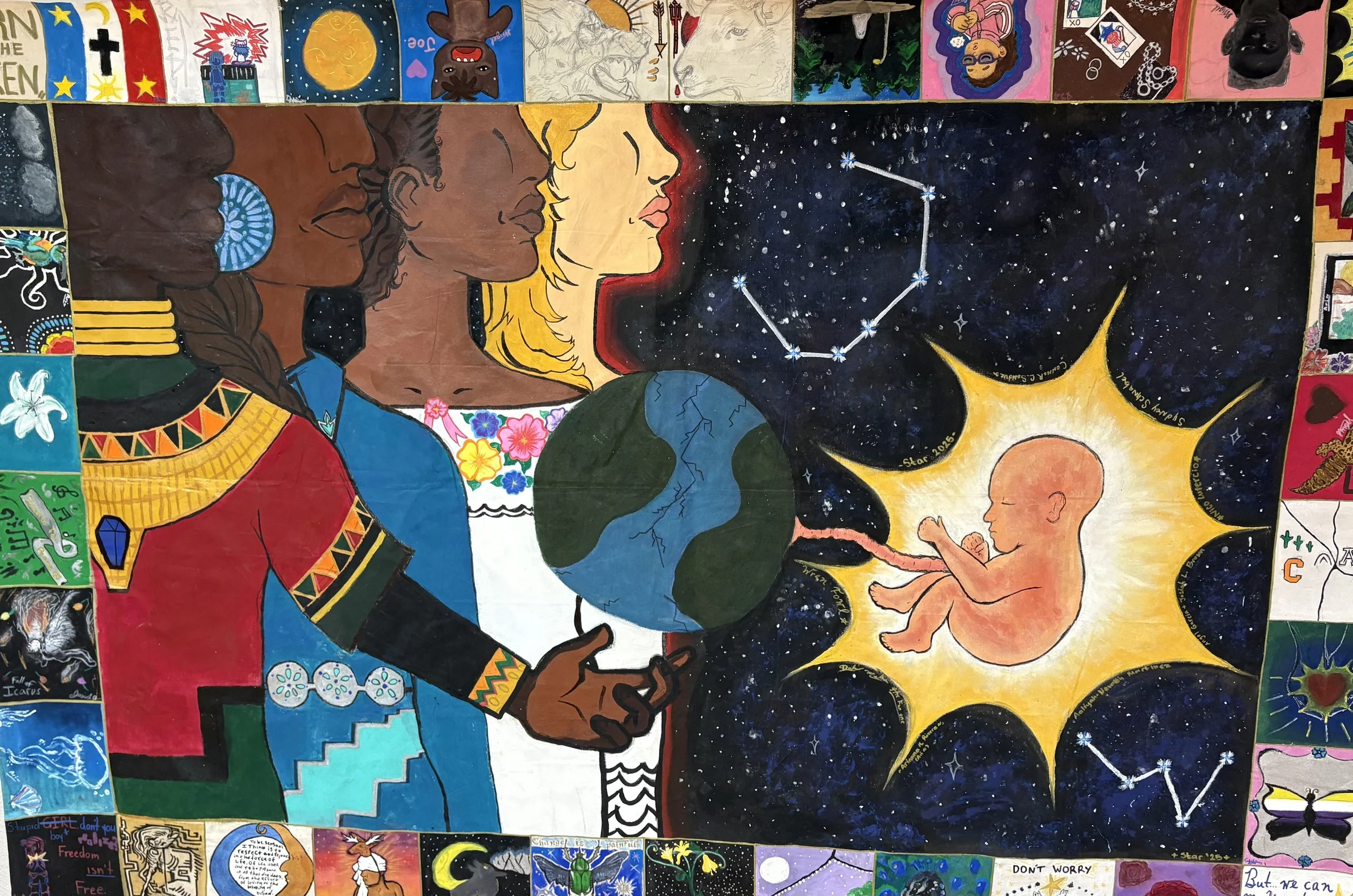
Born into the Broken
This collaborative artwork, created by First-Gen STAR students Angel Garcia, Nico Lupercio, Aaliyah-Nevaeh Martinez, Dale Meier, Wren Parker, Arianna Rivera, and Connor Sandura, draws inspiration from Wislawa Szymborska’s Children of the Age, which reminds us that all aspects of identity and existence are inherently political. Rooted in Dr. Cuevas’ Introduction to Ethnic Studies course and based on his published curriculum and research, the piece challenges false narratives passed down through generations while affirming cultural heritage as a source of resilience, transformation, and hope. The central image of the world being handed to an infant connected to Mother Earth symbolizes how identity is shaped politically from birth and reflects Critical Race Theory’s assertion that race and power are embedded in all systems and social experiences.
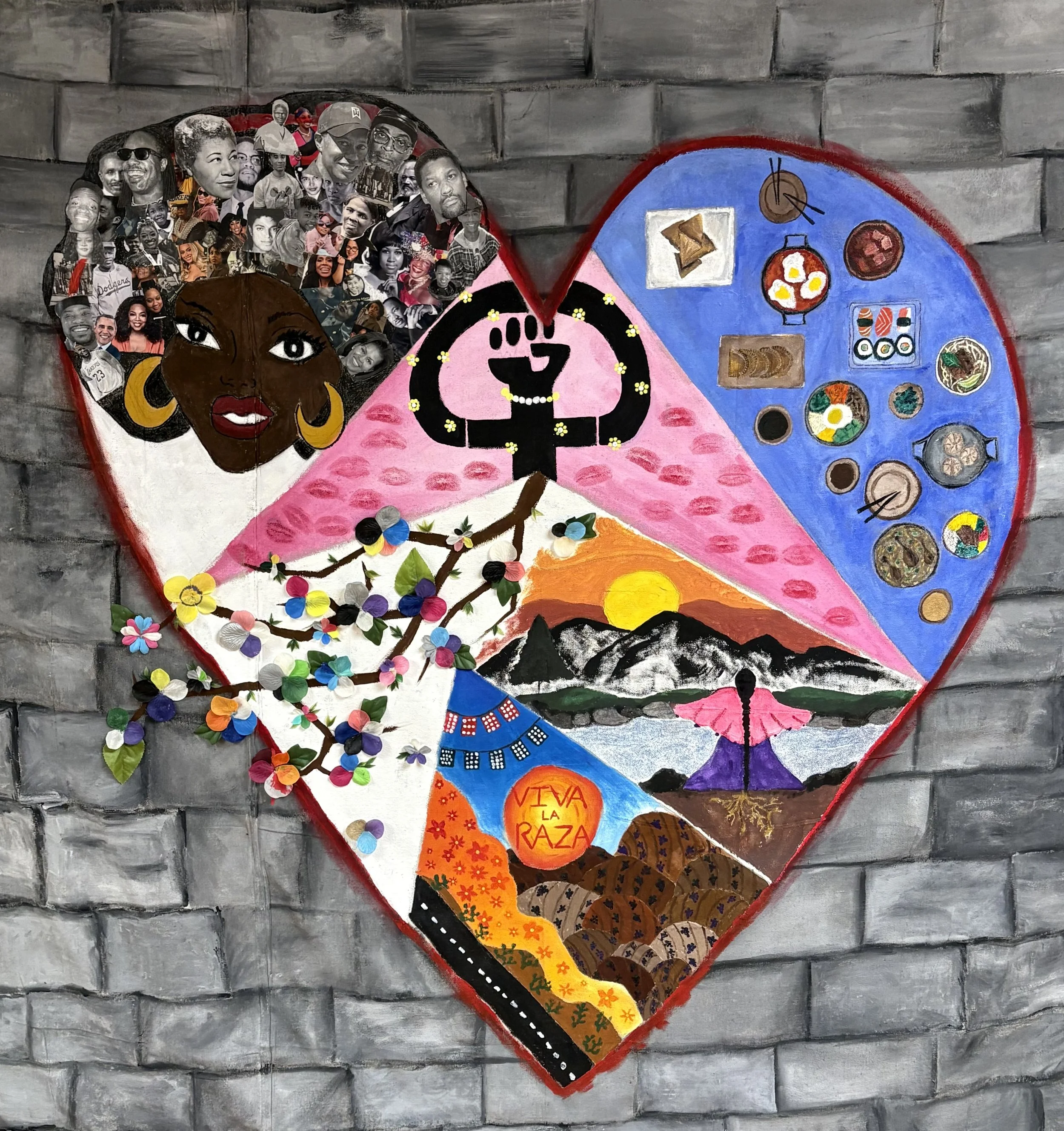
Together We Are One
Artists: Ryenna Lee, Megan Houser, Julie Lewelling. Nariah Tanner, Ollie Fontes, Paulo Freire and Maya Angelou
Artist Statement:Together We Are One, represents six marginalized communities in the United States: Black Americans, Native Americans, Asian and Pacific Islanders, Hispanic and Latinas, members of the LGBTQ+ community, and women. The red heart, fragmented into six sections, symbolizes intersectionality and the idea that these communities are distinct yet interconnected parts of a greater whole.
The Asian and Pacific Islander section was painted by Ryenna Lee. She drew inspiration from the diverse foods she shares with her family. Recognizing the variety within this broad cultural group, she chose to represent its many traditions through food. Megan Houser, inspired by her family's culture, painted the Indigenous section, depicting a woman with her hair braided into the ground, symbolizing her as the "root of the land." With arms wide open, she overlooks
the sacred land that has belonged to her people for millennia. The section representing the unity of women was painted by Julie Lewelling and Nariah Tanner. They decided to represent this community by painting the symbol for women with a clenched raised fist in the middle. The fist universally expresses unity, strength, and resistance. Putting this symbol in the center was an
active choice because it can be a symbol for multiple underrepresented communities. Julie Lewelling and Nariah Tanner also created the African American section. This is represented by an African woman with her hair being filled with African American icons, activists, and family members. This display was to bring attention to all the African Ameircans that shape our culture. Ollie Fontes painted the section representing the LGBTQ community, featuring a tree branch with gender and sexual identity flags on its petals. This symbolizes the interconnectedness of the community, where minoritized groups support and build each other, much like the overall layout of the art. The hispanic section of the mural was painted to show different aspects of hispanic culture and empowerment. The statement “Viva La Raza” translates to long live the people or the community. Freire talks about how in order to free ourselves we must in turn free our oppressors as well regardless of the work or pain put into it. Liberation is thought of as childbirth. Hard and lengthy but rewarding in what comes from it. Throughout the semester, the articles and films highlighting the oppression and social exclusion these groups face inspired us to reclaim our voices. Our piece relates to the narratives brought to light in Pedagogy of the Oppressed by unifying various communities that have and continue to experience injustice and oppression. However, through unity, resilience, and collective action, we can create a more just and inclusive society. We chose to take action by collectively creating an art piece that brings together oppressed communities and therefore shines a light on their values and voices. As Paulo Freire and Maya Angelou so wisely realized, no one can be free until we all are.
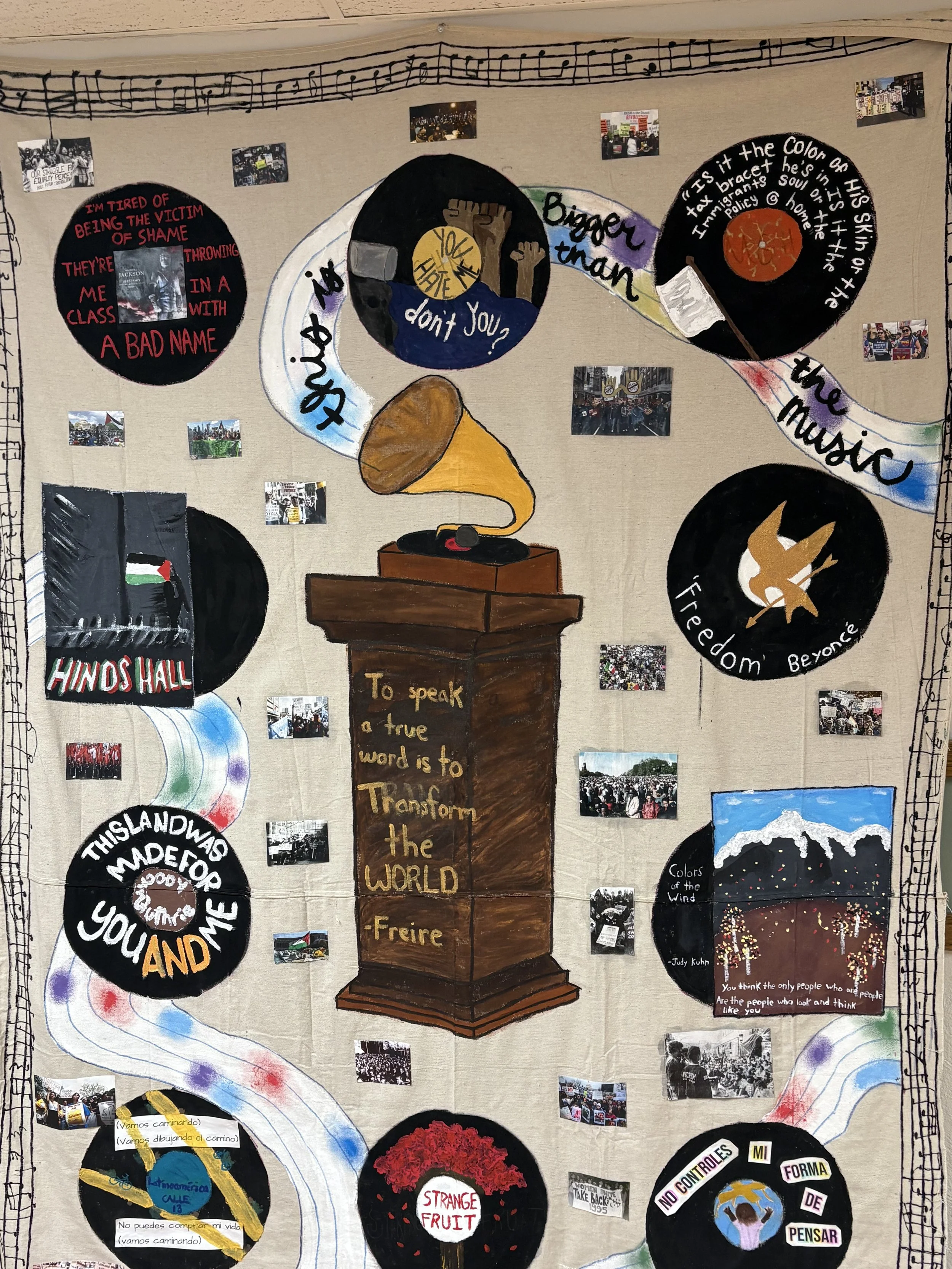
On The Record
Artists: Makayla Harmon-McIntosh Violette Valencia, Kalena Gulchak Sydney Pax, Natalia Tucker
Artist Statement: The artists of “On The Record” are all women with a desire to change the world through their respective degree ventures. Rooted in principles of Critical Race Theory, our work explores how identity, knowledge, and power intersect within higher education, society, and beyond. Each brushstroke represents a dialogue between lived experience and scholarship—between who we are and what we are told we can become. The creators of this mural include majors such as journalism, sociology, environmental studies and sustainability, nursing, criminology and criminal justice. These experiences have shown us that bias is inherent in many aspects of society, especially in its legal and social institutions.
In creating this piece, we drew on the principles of Critical Race Theory to challenge the dominant narratives about who holds knowledge and whose stories are centered over others.Together, we used our collective artistry to visualize solidarity, resistance, and the transformative potential of education. This mural represents both our differences and our unity—our refusal to be defined by a single narrative, and our belief in art as a space for empowerment and truth-telling.
Music is one of the most potent weapons against injustice, able to cross cultures, languages, identities, and nations. Our piece “On the Record” explores the connection between music —specifically lyrics —and protests occurring during the time periods when certain songs were released. In the center of the piece is a podium with a record player on top, with lyrics that say, “This is bigger than the music,” calling attention to the fact that music is a way of playing counter-narratives and recognizing history, social inequalities, and injustices. The orchestrator of this music is the new generation, students like us who want to share the stories of those who came before us. The latest generation is actively reviving these messages to prevent the rest of society from repeating the past. Every record incorporates a distinct song of rebellion with lyrics, art related to the song, and pictures. Each record is a unique song, from a different culture by an outspoken artist. Etched on the podium is a quote from Pedagogy of the Oppressed: “To speak a true word is to transform the world,” as powerfully stated by Paulo Freire. The piece places music at the center of resistance, using the record player and podium as symbols of both storytelling and authority. This work connects music with the rebellion of the oppressed. Music has been a field of expression for centuries, allowing people without a voice to express themselves and create more for themselves and others. On the Record is significant because it captures how art and sound serve as powerful tools for liberation and collective memory. By having the orca initiate the records, we represent the voice of the silenced—the ones who are often left out of history’s dominant narrative—taking control of the narrative and spinning it anew.
This idea resonates deeply with Paulo Freire’s Pedagogy of the Oppressed, in which he argues that education and communication can awaken critical consciousness. Just as Freire emphasizes dialogue as a form of empowerment, our piece transforms listening into an act of resistance—encouraging audiences to engage critically with the messages embedded in the music.
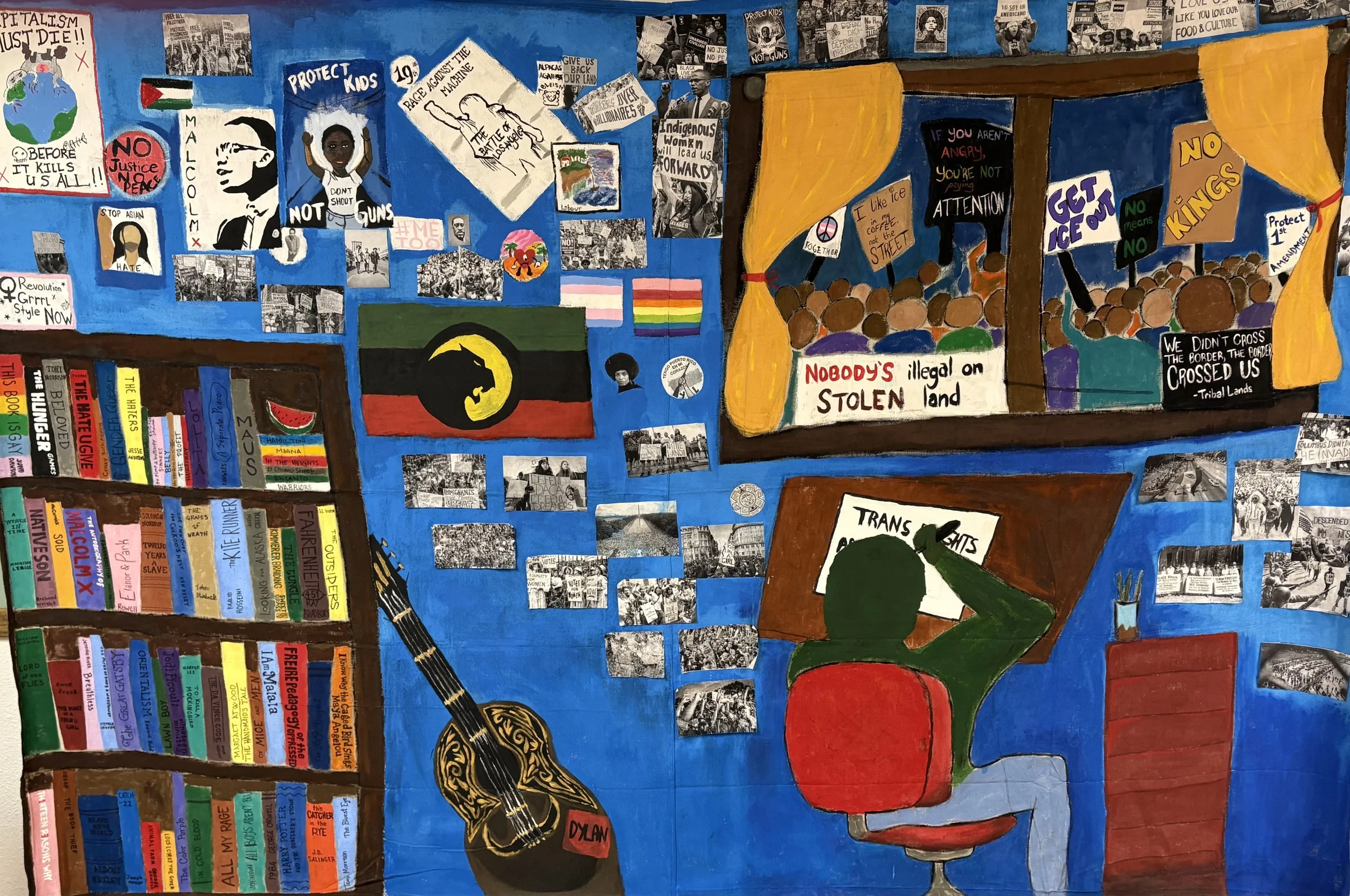
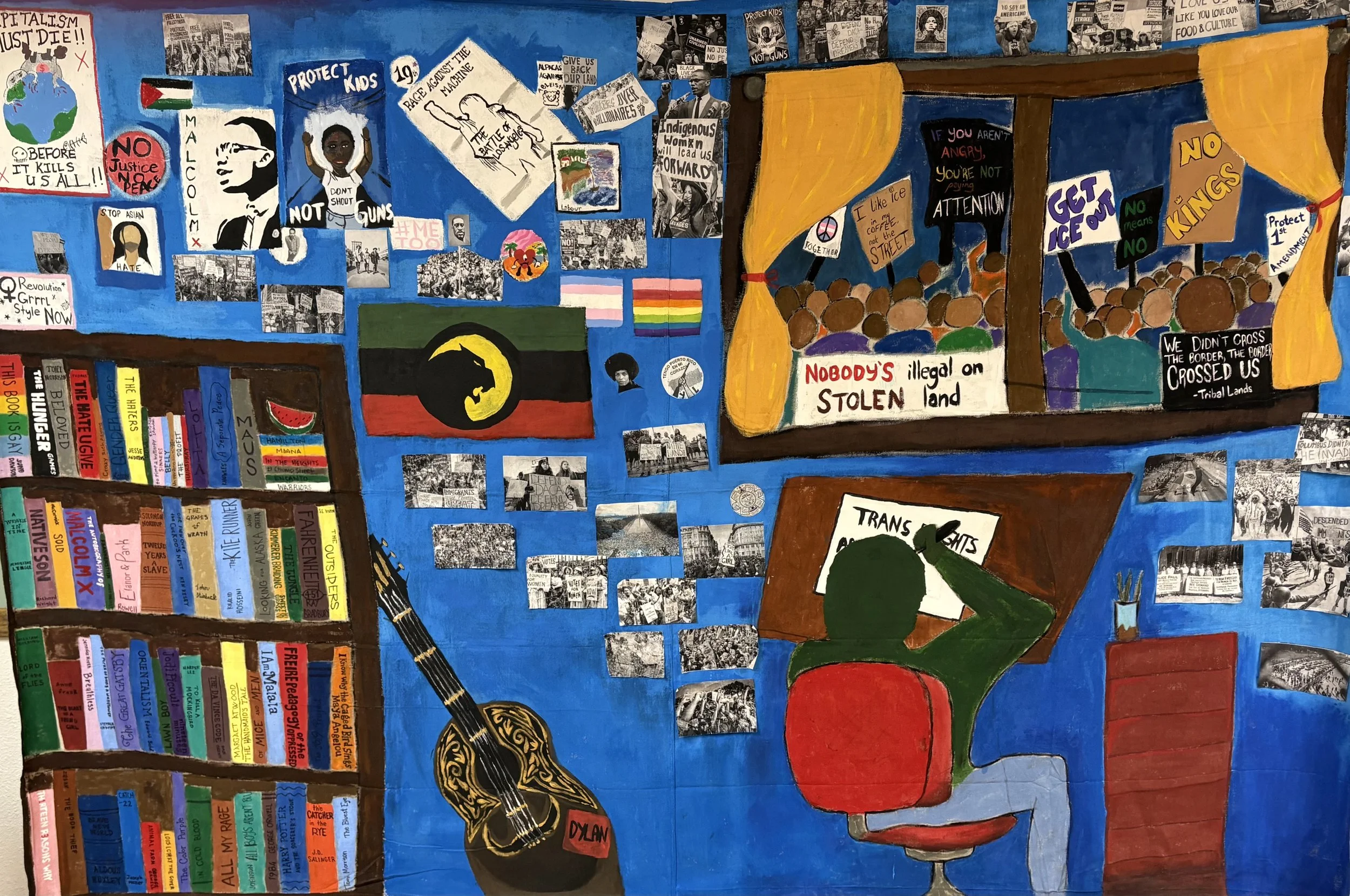
Mirrored Media
Artists: Jayden Mallett, Denali Greek, Lacie Breaux, Julia Diaz, Annabelle Lawrence, Reegan O'Rear, Grace Price, Alessandra Rodriguez
Artist statement: As a diverse group of young adults, who have all dealt with the injustices and issues within our world, we felt the need to illuminate the necessity of accomplishing meaningful change within our lifetime. Even though we all come from different backgrounds, we share a love for art, specifically art that provokes emotions that lead important causes to gain momentum. We wanted to create a mural that speaks to what it means to be a member of our generation, looking at how people in the past have resisted oppression and using that history as a guide for resisting the oppression, suppression, and censorship of today.
The mural focuses on the concept of cyclicity, and how our fight does not live within a vacuum but rather a years-and centuries-long fight for rights, and how we can learn from the people who spearheaded these movements. Mirrored Media elicits the same action that Freire talked of within Pedagogy of the Oppressed, where we assess past protests and educate ourselves. Taking the power of education back and humanizing the history of resistance to hopefully “[stop] regarding the oppressed as an abstract category [but] see them as persons who have been […] deprived of their voice (Freire,p. 50).”
The books, records, and other artifacts of history portray the teachings of oppressed peoples and resistance movements that have been left behind for people today to understand and build from. Some of the books featured were covered in class, others were books pulled from the banned book list, highlighting the silencing of communities. The rest of the mural represents that building process, as the person on the bottom is working on resistance media of their own, and people right outside the window are pushing for the same change that produced the symbols of resistance displayed around the room.
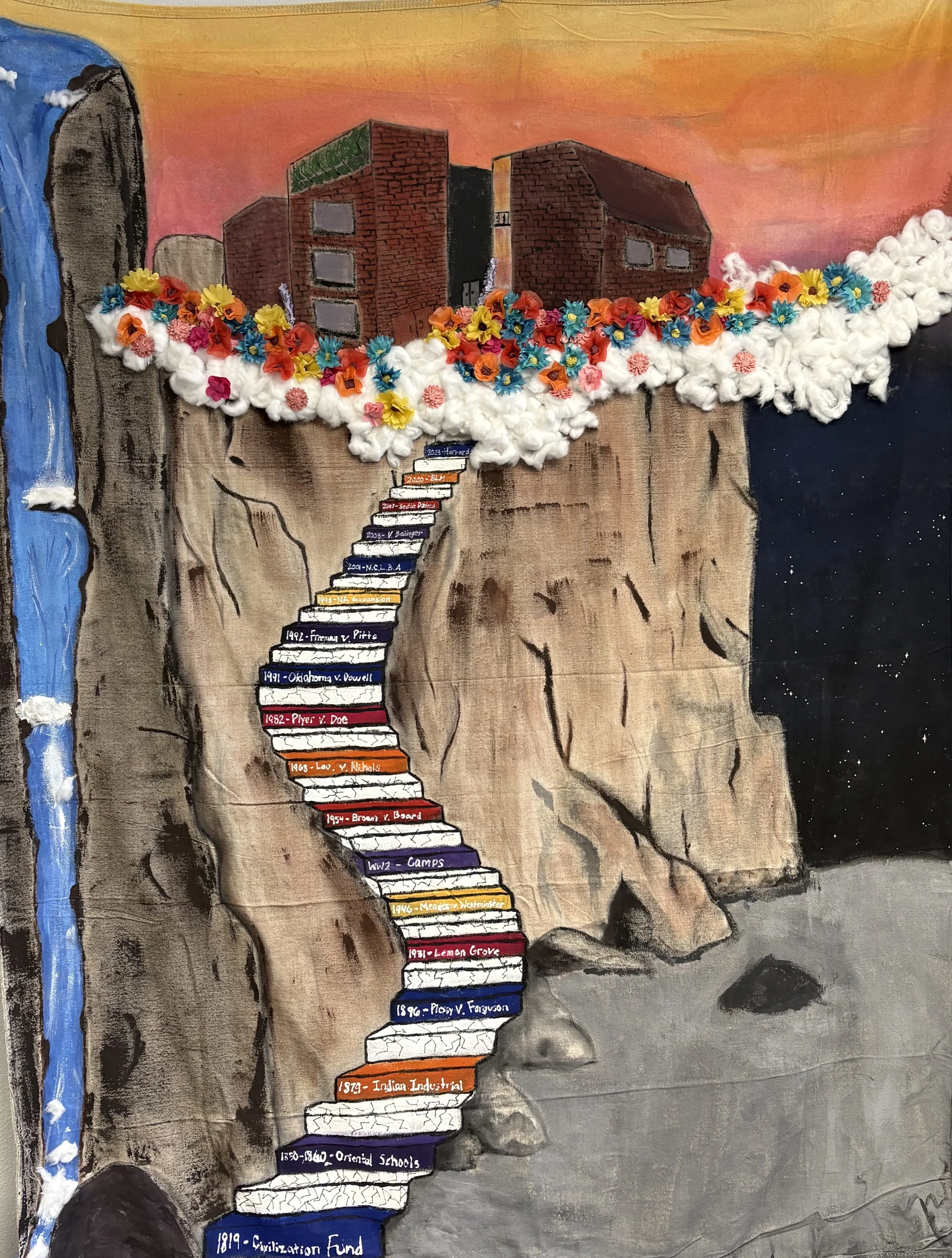
Paint Your Path To Education
Artists:Alex Martinez, Mia Hiniker, Karina Mitchell, Axel Martinez, Ernesto Solis Mata, Brooklyn Walk, Josh Francisco
Artist Statement: We are a group of diverse kids coming together to showcase our ability to learn, collaborate, and conquer the challenges of society. Although many of us joined this class to fulfill a college credit requirement, we can all agree that this assignment has opened our eyes to the cultural differences and challenges that many have faced not only in the past, but also in the present. We hope that this mural will help open others' eyes and aid in the process of stopping the pattern of inequality that continues to persist through generations. We hope to provide a loving and accepting future for all through this painting. This mural is titled “Paint Your Path To Education". We chose this title because our mural is a large staircase, indicating the journey to getting an education, which is tedious and challenging. It is on a rocky cliff to demonstrate the rough path ahead. The bottom of the mural is painted with dead flowers and cracked old stair tiles. to symbolize how this country was built upon unequal laws, racism, and greed, creating a broken foundation that struggles each year to hold the new” foundations” of generations. The obstacles that some people go through can vary from person to person. Some people are born with easy access to education, while others have to fight tooth and nail to be able to get the same education that others have been handed. Our staircase has events in the United States, both positive and negative, that have had an impact on the education system. This helps the viewers understand that some of the obstacles that people had to go through weren't small inconveniences, but came from their government, which is supposed to help and support all of its citizens. Even now, in the present day, there are still many aspects that stunt access to education. As the staircase continues to climb, the environment around them starts to brighten up. Once it gets to the top, the stairs disappear into a world of clouds where a school emerges in a beautiful sunset with bright poppies. The clouds symbolize the dreamt-up world where everyone is given the same opportunities to learn. The red poppies symbolize remembrance and sacrifice, the orange symbolizes energy and resilience, and the yellow symbolizes success. In addition to the main part of our mural, we have another cliff that shows us there is beauty in it all. It has a waterfall that goes from top to bottom. It also symbolizes a cycle that, even though some people can make it to the top, it does not mean that their descendants will have the same journey or opportunities that they had. It shows that each generation will have different obstacles and challenges that they will face that are completely different from those that came before them. This is shown by the waterfall because even though it's beautiful, everything could be wiped out, and the descendants might have to start from the bottom. Our “why” is supported by our own understanding and analysis of the deculturalization passages given to us in this class. We made sure to include dates that provided support to the education system’s ethnic growth, and dates that show why we are still struggling to provide equality to all. The dates are spread by occurrence as they go up the stairs. Although the stairs going up should represent the lack of discrimination in education, that is not the truth today. There has been growth and restrictions, even as far as this year. This mural shows the rocky path this country has taken, along with the magnitude of change we need to go through in order to be successful. We encourage all viewers to take a step back and review their role in educating our future children, stopping racism and discrimination once and for all.
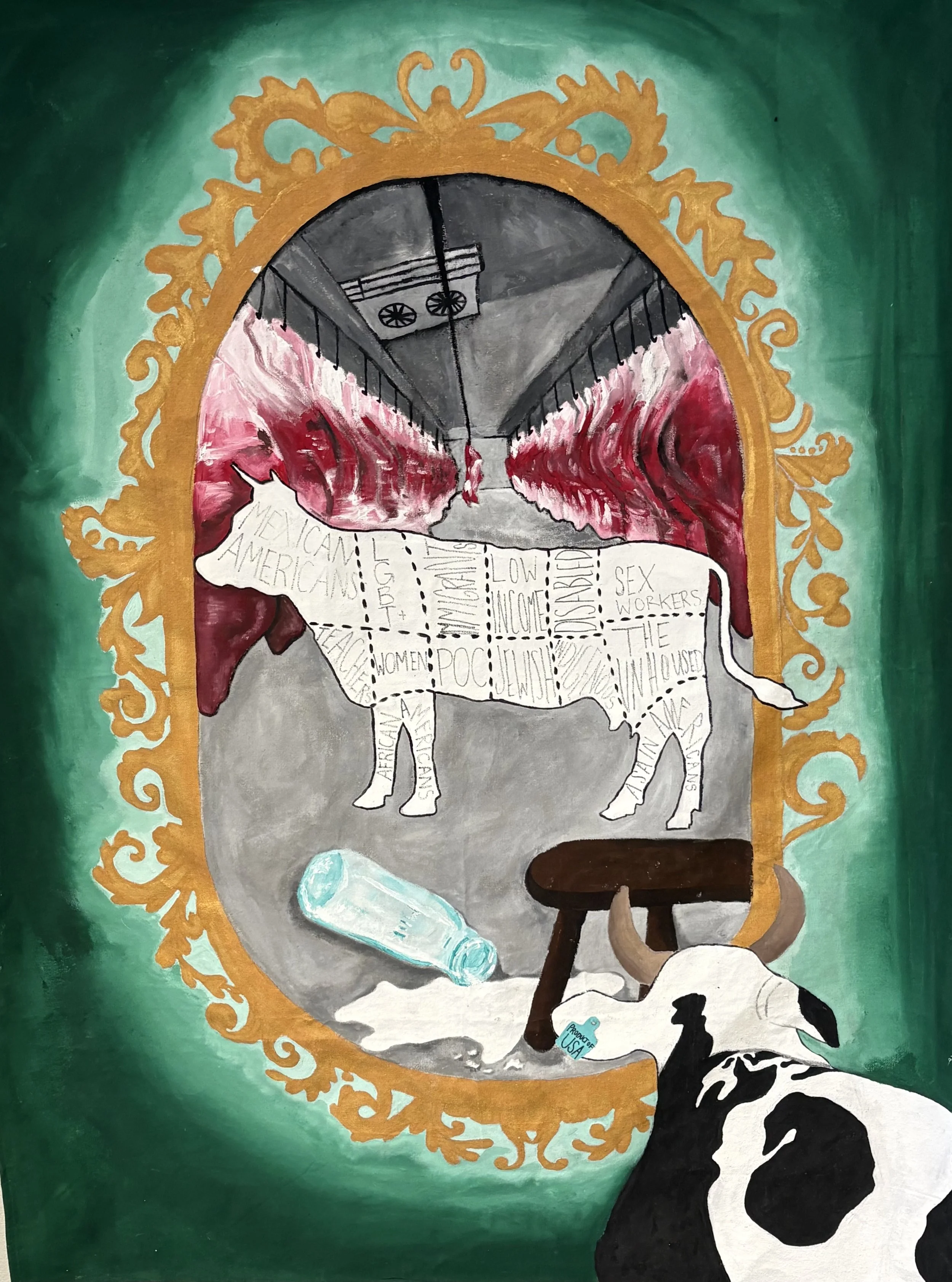
Living Product
Artists: Dawson Hernandez, Courtney Brown Ira Vaughan-Wiltsee, Yesenia Kanney,Valerie Partida; We are group members in an ethnic studies class who through creation were further connected.
Artist Statement: Our mural Living Produce depicts the struggle of many marginalized groups in the United States with value, perception, exploitation and assimilation. The cow in this mural is looking into a magic mirror that will show its future. The image reflected back is of a slaughterhouse and an iconic poster often found in butcher shops depicting the different cuts of meat. In our society we often separate ourselves from the grotesque or uncomfortable ways we turn living things into products by calling them something other than what they are (i.e. Sirloin, ny strip, etc.) We put labels on dairy processed in factories that show idyllic farm scenes. All of these ways we sugar coat reality allow us to consume and exploit without a second thought. Our group came up with this idea and related it to our feelings around the oppression of marginalized groups in America. As we all identify as members of different said groups we have felt that not only have stereotypes and labels acted to dehumanize us and others but that our identities and hopes for our futures have also been co-opted and exploited by the mainstream. In addition, exploitation also comes from the idea that we must conform to the values of society in order to be accepted and deemed valuable, further perpetuating the cycle of oppression and dehumanization. Dream the American dream but be warned that the cost might be your humanity. It was also the group's belief that depicting stereotypes in some sense enforces them and we could better convey our message through metaphor. Instead of a race or subsect of people our subject is a cow here in america. An animal widely accepted here in the states as a product of the meat and dairy industry. Our group felt we can pull attention to the life we expect and place on these animals much like the ignorance and barriers the American dream places an expected path on those who are marginalized.
Textual Connection: In class, one of our first readings was chapter 1 of Pedagogy of the Oppressed by Paulo Freire. Within this chapter, he emphasized on the oppressor-oppressed cycle. The oppressor uses the authority they have to treat the oppressed unjustly and harms them in many ways. This dehumanizes the oppressed, or treats them as less than human. The way cows are depicted in the States “dehumanizes” what they are. People, the oppressors, use the cows, the oppressed, to satisfy their own needs by raising them in isolation, using them for their own benefits (acceptance and a better standing in society). They are seen as a product, raised mainly to be slaughtered to satisfy the human race. They are also seen as dairy machines, expected to provide milk or cheese products. Just like cows are dehumanized by the human race, many minority and marginalized groups are dehumanized by society as a whole.
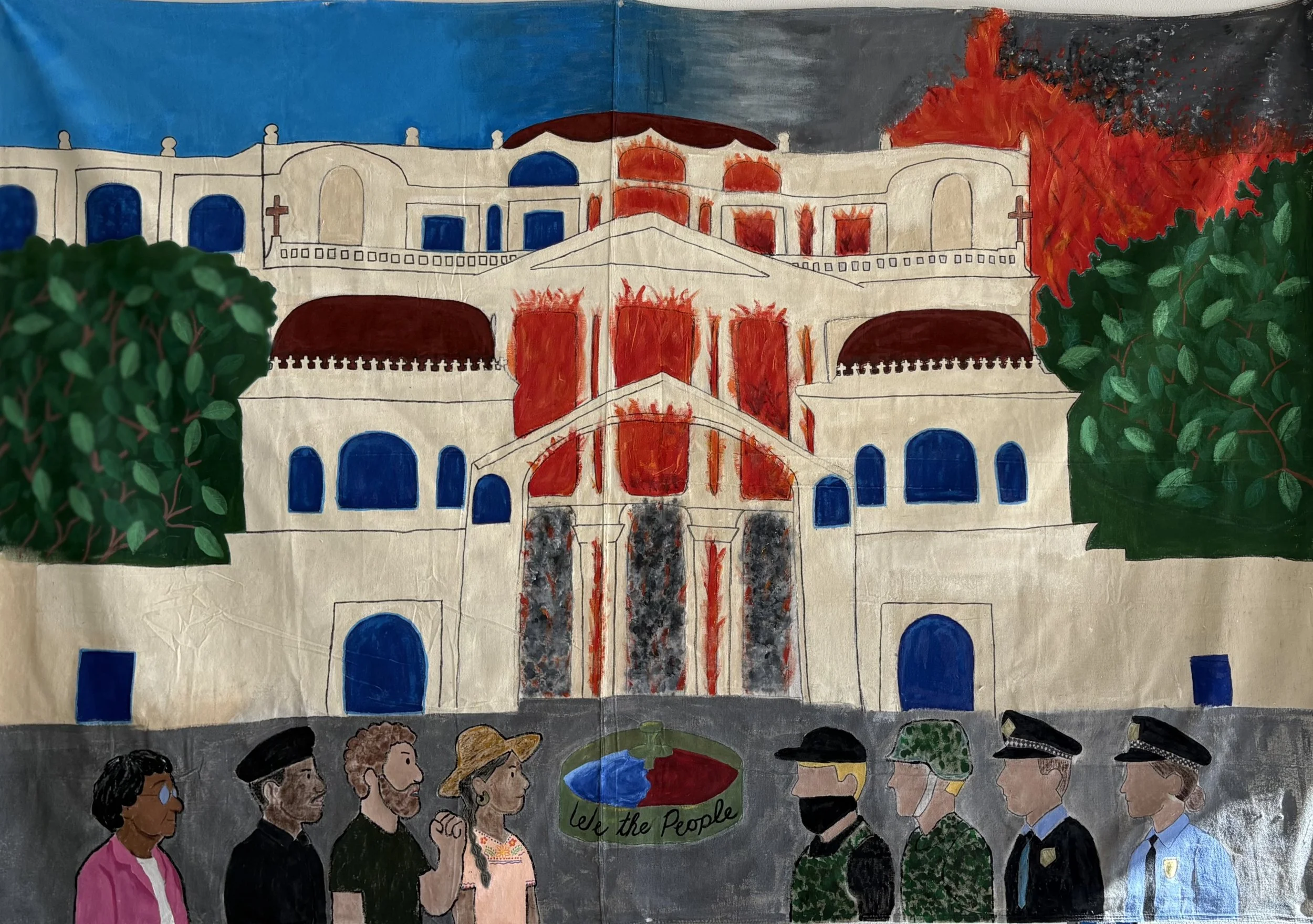
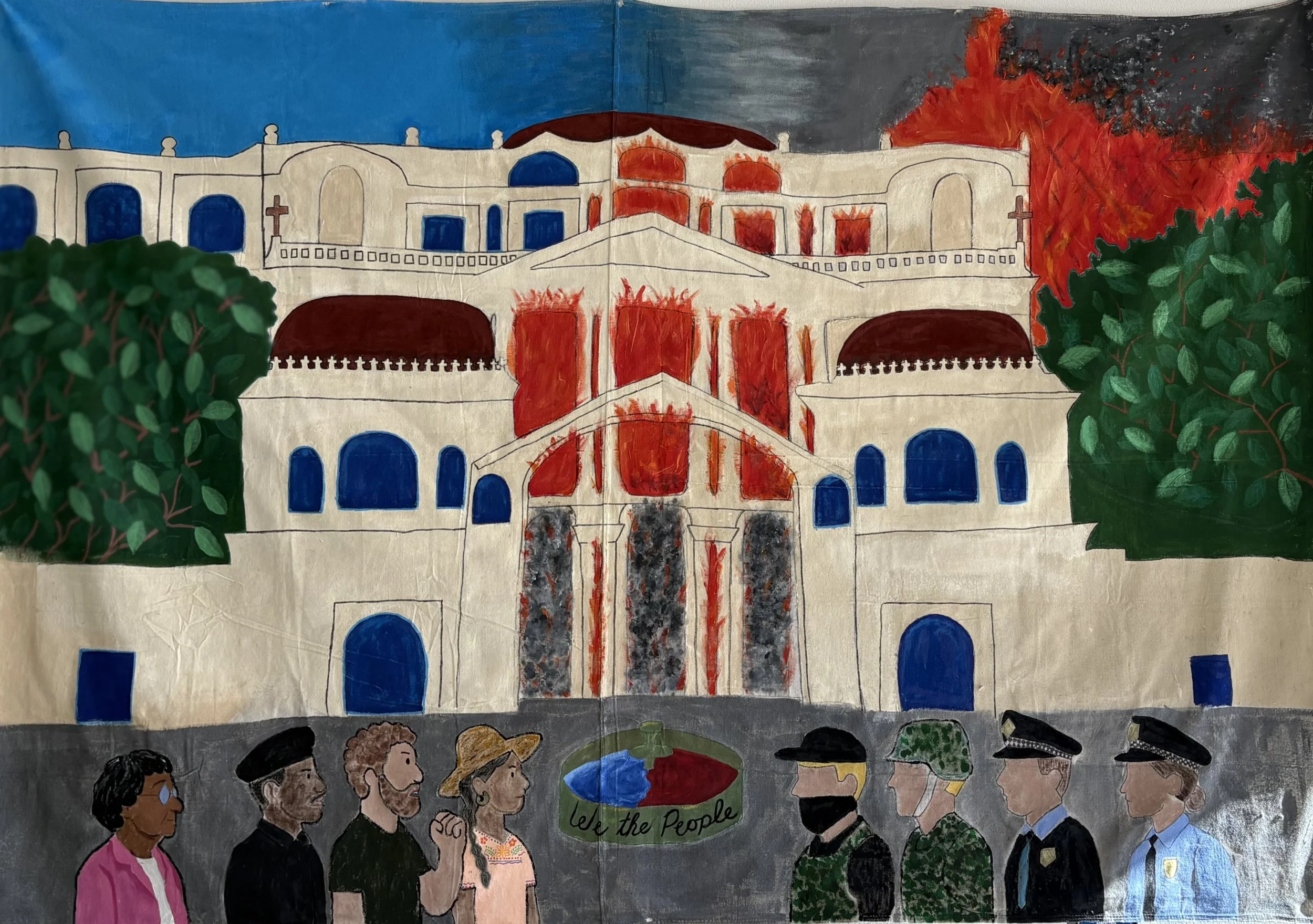
The Power of Protest
Artists: Lauren Mendoza Isaac Montes De Oca, Seamus Garvin, Clint Lee, Brianna Cardenas
Artist statement: We are students at Northern Arizona University who are diverse, globally minded and consider the ways that youth can affect change against the oppressive systems of modern day. In creating our mural we thought about physical symbols of the youth taking back their power and working to free both themselves and their oppressors. For this reason, our mural depicts the September 2025 Nepalese anti-corruption protests, which were led by young adults (mostly Gen Z) and led to the resignation of the country’s prime minister and hopes for a better direction of their government; one free of corruption. The two sides of the mural are meant to represent the counter narratives of the oppressed and the dehumanization of their oppressors. We chose to give faces to the oppressed in an attempt to humanize them and elevate their narratives whereas we left the oppressors faceless because they are bound by an oppressive system. More specifically for the individuals we drew inspiration from current and former powerful movements such as the fight against deportation, the black panther movement, and the Kent state protests and the tragedy that followed. We explore the idea that the youth are constantly fighting for all those that came before them, and all those that will come after. The fountain between the two sides with the words “We the People” is meant to inspire the audience to consider how the global and historical battles for humanization connect to American policy and ideals. We also wanted to highlight the tragedies that often occur during these fights by splitting the fountain into 2 with one side running clear and the other running red with blood. In Pedagogy of the Oppressed, Freire asserts that it is the responsibility of the oppressed to fight for the humanization of all people and put systems into place that protect all of humanity.
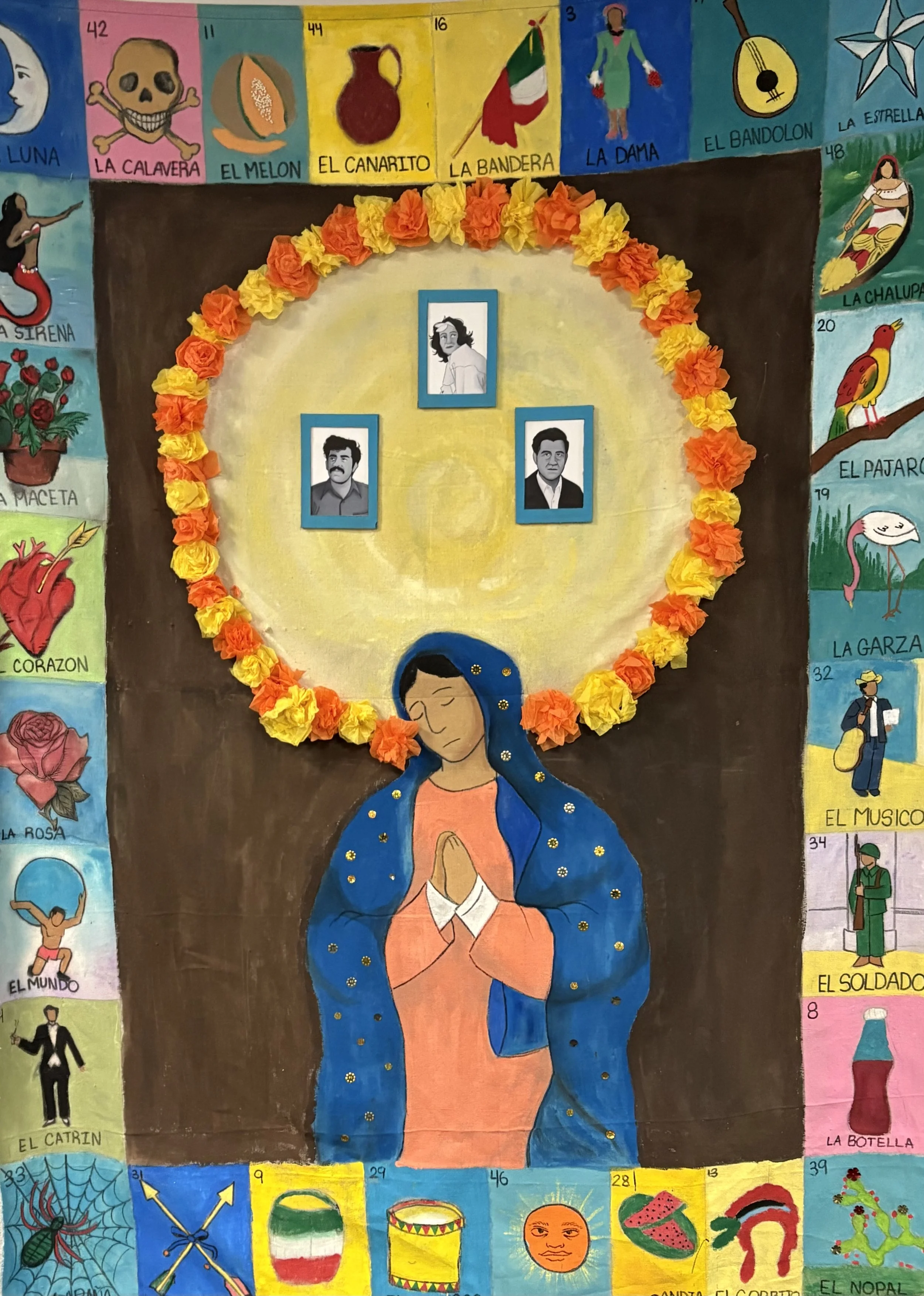
Gamble of Culture
Artists: Helena Reardon, Neviya Mendez, Yuliana Reyes, Leslie Bandera
Artist Statement: For our project, we as a collective decided to form a group of students coming from different backgrounds with like-minded ideas. We all had similar ideas as well as different ones, and combined them all to create something as a collective. Our concept incorporated the game of loteria, which brings people together with fun, and ties it into Día de Los Muertos. We also decided to feature people who helped shape powerful movements or made a major impact, such as those we learned about in class, inside a mini ofrenda on our mural.
Using ideas and people from the films and media we learned and talked about in class, like Silvia Rivera, Cesar Chavez, and Rodolfo “Corcky” Gonzales, to inspire our project. All these people advocated for their own rights and the rights of others. Silvia Rivera was a Latina transgender rights activist, a veteran of the Stonewall uprising, and a co-founder of the street transvestite action revolutionaries (STAR). Cesar Chavez was a civil rights, Latino farm labor leader. He was a religious and spiritual person who made a major impact and change in the environment and consumer rights movement. Roldofo “Corcky” Gonzalez was a Mexican-American boxer, poet, political organizer, and activist who was one of the many leaders for the crusade for justice in Denver, Colorado.
We also incorporated themes and ideas of the pedagogy of the oppressed in our mural. We wanted to show how people choose to c e together and express their culture instead of oppressing it. By incorporating loteria and Mary, we incorporated a game and religion, combining two things that bring people together. Having Mary as our centerpiece is a statement against oppression, as she is often seen as a symbol of protection and comfort, especially in struggles of immigration, poverty, and other forms of oppression.
Together, we as a group incorporated many like ideas and different ideas. By combining these, we created a mural that shows how people put aside their oppression and come together and embrace their culture. Our mural showcases the strength and unity that arise when communities struggle and celebrate their communities over shared identity. The element of our artwork represents the beauty of diversity and the power of collaboration. That helps remind us that when our voices and ideas are joined together, we can create significant communities and statements.